Hello members new and old (and young!) It seems like this winter will never end, but spring will surely start to unfurl as the month marches on.
In the meantime, please spend a few minutes looking at some wonderful images by our club member and HNPNC secretary, Anne McDermaid, on this website. Not only will you see a gallery of her inspiring landscapes, but also some beautiful shots of waterfowl in winter. Thanks Anne! We encourage other members to share their work on our website or Facebook pages. See contact info below.
We are also getting thoroughly modernized and now have a Twitter account: @hnpnc launched January 31st with 211 followers.
On February 27, 2014, the International Joint Commission [I.J.C., 2014] released a report on the most recent algae bloom problem in Lake Erie. That report had much in common with a similar problem that existed in the Great Lakes about 50 years before. That problem was the association between phosphorus loading in the water column and the subsequent growth of algae, most conspicuously Cladophora glomerata, though blue green bacteria and other species constitute additional problems.
Figure 1. Cladophora on shore of Lake Ontario at Lorne Park, Mississauga, 1969. Photo from Mississauga Public Library collection.
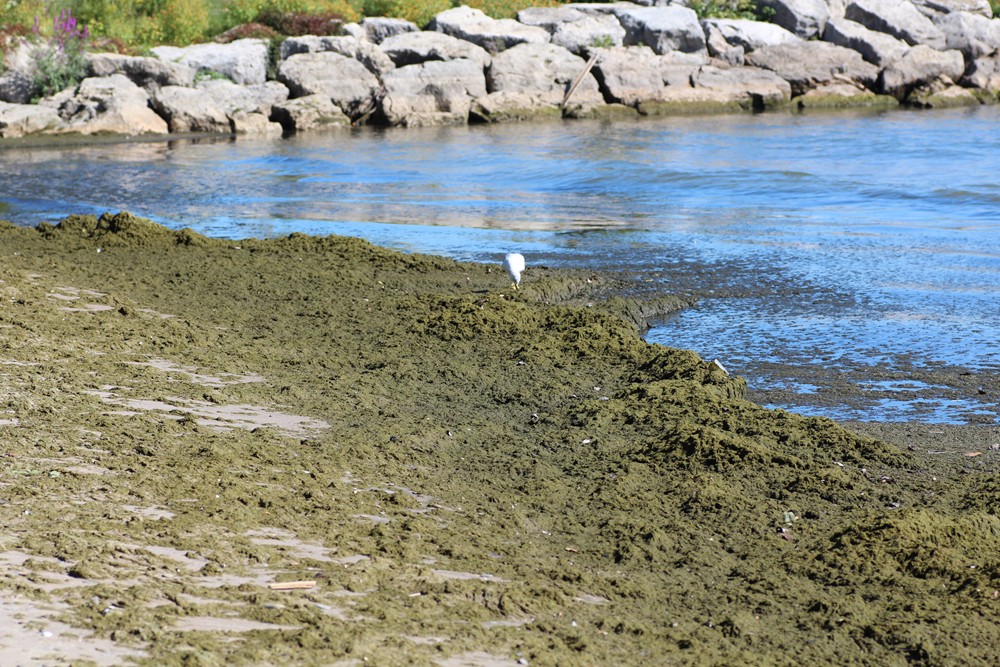
Algae, like all aquatic organisms, are dependent upon the chemical constituent chemicals in the surrounding water. Generally, chemical concentrations in the water are quite dilute. As it turns out, the essential chemical that is most limiting for algal growth is phosphorus. As a result, small increments in the level of soluble phosphorus cause large responses in growth of the algae. When phosphorus levels in lake water increased up into the 1960s, excessive growth of algae occurred in the Great Lakes. The algae washed up on the shores of the lake (Figs. 1 and 2) where it began to decay and caused very unpleasant odors. Decaying algae consumes oxygen and when this happens in the aquatic environment, the eutrophic conditions with insufficient oxygen become limiting to many organisms including fish.
Figure 2. Cladophora on shore of western Lake Ontario 1969. Photo by W.D. McIlveen
There were many sources of the phosphorus, however, the prime source was attributed to detergents used by human residents around the lakes [Schindler, 2008]. Despite fierce resistance from the soap and detergent industry, they were forced to remove the phosphate-based chemicals from their product by 1972. Following this, phosphorus levels in the water gradually declined and the algae problem generally improved. The removal of phosphorus from detergents did not permanently solve the problem. There was year to year variation in algae growth and the problem appeared in years of heavy growth (Fig. 3).
Figure 3. Cladophora on shore of Lake Ontario at Jack Darling Park, Mississauga, Sept. 11, 2011. Photo by W.D. McIlveen
Over time, the human population around the lakes increased further. Other sources of phosphorus grew including releases from sewage treatment plants. As well, new complicating factors appeared. Global warming caused earlier warming of the near-shore waters with the result that alga populations could become established earlier in the Spring. The appearance of the Zebra (Dreissena polymorpha) and then Quagga (Dreissena bugensis) Mussels made major changes in water quality. These species filter huge quantities of water with the result that water is made clear. With clearer water, light could penetrate to greater depths and this effectively extended the area over which the algae could attach and grow. More growth means more problems. Other introduced species such as the Round Goby (Neogobius melanostomus) and large populations of waterfowl that now feed on the mussels further complicate the picture.
In Lake Ontario, the water current in the western portion of the lake is generally counter clockwise when seen from above. This means that the currents along the shoreline off Peel and Halton are from east to west. The Halton shoreline is therefore downstream from any sources of phosphorus in Peel and the City of Toronto. In addition, the nature of the shoreline with piers and other structures influence the movement of the water and can cause floating algae to become trapped. Winds and storms can deposit, and remove, algae on the shore where it is an unwelcome caller in the minds of local residents.
The recent report by the IJC [IJC, 2014] has concluded that the most recent problem of algae in Lake Erie was mainly due to agriculture. This includes large animal production facilities and heavy use of fertilizers for crop production around the Lake. As well, residential use of fertilizers for lawns and gardens contribute a significant amount of phosphorus. The latter source was also confirmed in studies completed in Halton [Aquafor Beech, 2006]. These sources need to be addressed or the eutrophication problem will persist and grow. It is still too early to know what measures will be undertaken in coming years. Phosphate-free lawn fertilizer may be mandated for home-use for example. Conditions around Lake Erie must be altered or the algae issue will continue and grow. The so-called ‘dead lake’ state could return even though eutrophication actually represents a hyper-lively water body.
References Cited:
Aquafor Beech Limited. 2005. Final report prepared for Conservation Halton LOSAAC Water Quality Study. 127 pp.
International Joint Commission. 2014. A Balanced Diet for Lake Erie: Reducing Phosphorus Loadings and Harmful Algal Blooms. Report of the Lake Erie Ecosystem Priority. 100 pp.
Schindler, D.W. and J.J. Vallentyne. 2008. The Algal Bowl – Overfertilization of the World’s Freshwaters and Estuaries. University of Alberta Press, Edmonton. 323 pp.
The Bumblebee nest boxes have arrived! Two members of HNPNC are participating in a citizen science project led by the University of Nebraska-Lincoln, researching how to build “better bumble bee domiciles”.
The boxes will be placed outdoors at the end of winter, before hibernating queens emerge and start looking for nest sites. We’re excited to get started, although at this point it’s a bit hard to believe that winter will ever come to an end!
Are you a birder? Are you good at identifying grassland birds by ear?
Credit Valley Conservation (CVC) needs your help on a one-day breeding bird survey or ‘blitz’ of meadow habitat in CVC’s middle and upper watersheds. During the blitz volunteers will gather information on the location, abundance and nature of the habitat that these birds require for breeding.
CVC is looking for people who might want to participate in this one-day event. The Bird Blitz will take place in June, with a 2 hour training session ahead of time. Volunteers will conduct surveys – in teams – from roadsides via a ‘point-count’ method.
If you’re interested in participating in the Bird Blitz, please complete the CVC’s online questionnaire. This questionnaire will help them set up the best dates for training and staging the event.
If you have any questions, please call Annabel Krupp at CVC, 905.670-1615 x 446
About the Grassland Bird Recovery Program
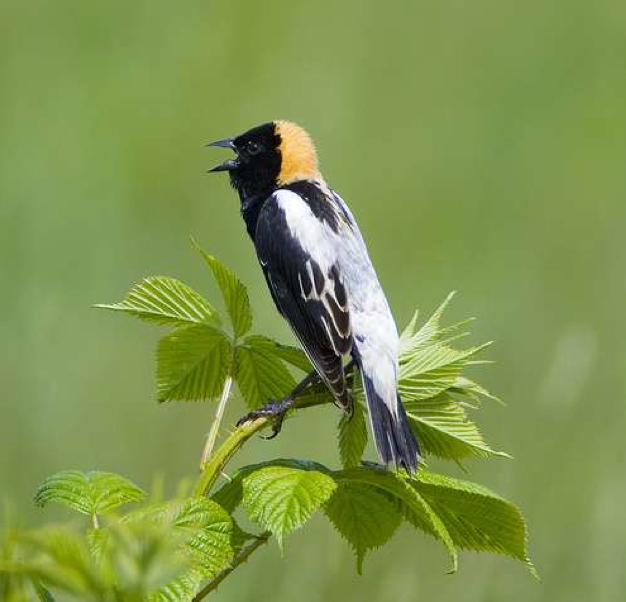
Local populations of grassland birds are finding it increasingly difficult to locate suitable habitat for breeding, nesting and resting. Species like the Eastern Meadowlark and Bobolink are declining and are now considered provincially at-risk, according to ecologists at Credit Valley Conservation (CVC). In an effort to better understand the issues affecting these species and take action to begin addressing their decline, CVC has instituted a pilot 3 year Grassland Bird Recovery Program. The program has received funding from the Ontario Ministry of Natural Resources’ Species at Risk Habitat Stewardship Fund.
White nose syndrome on bat. Photo by Jeff Normandeau
January and February are usually peak mortality months for bats suffering from White Nose Syndrome. But the The Canadian Cooperative Wildlife Health Centre (CCWHC), the organization that monitors health and disease in wildlife populations, is barely getting any reports. This could mean that bats aren’t dying or aren’t emerging early from hibernation into the non-stop polar vortex this year. But we all know that’s wishful thinking. The other, more likely option is that people don’t know who to call when they see a bat, and therefore we have no idea how far White Nose Syndrome has spread since last winter.
Ontario region: 1-866-673-4781
Other areas: click here
Describe the location as precisely as possible, along with the date that you saw or found the bat, and the bat’s behaviour. If you find a live, injured or unwell bat it can be sent to a local wildlife rehabilitation centre.
For more information on this conservation crisis and how you can help, please visit the Liber Ero blog.
And how incredibly welcome the New Year was, arriving shortly after power was at last restored. For me it was a 7-day blackout, and I know for others it was longer still. Being in a cold house in midwinter just makes me admire all the more the small birds and animals that brave the outdoors year-round. The chickadees at the feeder, puffed up in the cold, have to find food and shelter every day, and throughout such inhospitable weather. Don’t forget to help them out!
Our trees have taken a tremendous beating, their tops lopped off as it by a drunken giant wielding a very dull machete! It will be interesting to see how the new growth appears and it there is any benefit to this strange kind of pruning. In town, many trees were split in half. If you have lost a Weeping Willow or Norway Maple, now is a good time to consider replacing those non-natives with a native species. Native trees are adapted to local weather and they also provide food and homes for our native wildlife.
We have a great line-up of talks and several outdoor walks of interest coming up, so I hope to see everyone at these events.
by W.D. McIlveen – Halton/North Peel Naturalist Club
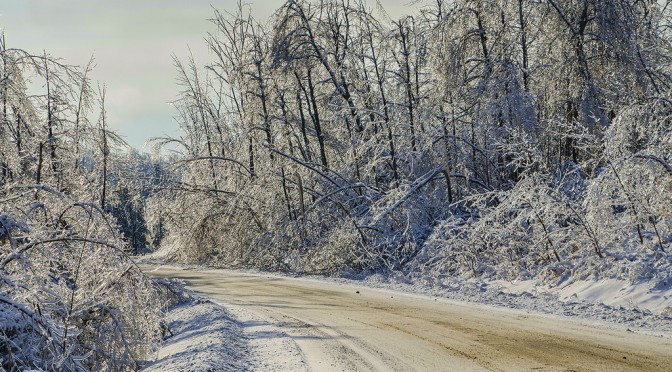
The 23nd annual Christmas Bird Count that took place on December 27, 2013 will be a most memorable one. The outstanding feature of the Count will be remembered not so much for the count results as for the weather that occurred a few days earlier. That weather included freezing rain that amounted to at least three cm of ice over all exposed surfaces. The consequence of the ice was extensive breakage of tree branches and electrical power outages that were still happening in parts of the survey area. Overall, there were 23 participants that took part in the field observations or checked their feeders.
Generally, the Count produced close to average results based on comparisons with previous counts in the case of numbers of species reported – 49 species on count day vs. 50 species for the long-term average. By contrast, the total numbers of birds seen was 5239 – slightly over half of the average of 9760. The results for the individual species are presented in the attached table. A new species for the Count was a Turkey Vulture that was reported to the OntBirds website. Only one species, the Red-bellied Woodpecker was present in record high numbers with 15 birds seen. Many species were reported at low numbers, both below average and at new lows. The new low numbers were noted with Mallards (26), Black-capped Chickadees (243), American Tree Sparrow (55), and Northern Cardinal (22). No Black Ducks were observed. Wild Turkey (50), Hairy Woodpecker (26), Blue Jay (171) and American Robin (95) were noted in above average numbers but not in record high numbers. The species that made it onto the Count Week list were Snowy Owl and Snow Bunting.
The impact of the ice storm that appeared to generally lower the observed bird populations cannot be assessed with any certainty. In part, the lower numbers of ducks and geese might also be correlated with early freeze-up of local water bodies. This would not explain the lower numbers of the more-terrestrial species. Only time will tell whether the decreased numbers are merely a blip or part of a long-term trend.
Our party of two had a great outing to this urban park. It is closer than Leslie Street Spit, with a lot less walking and some really good wetland and lakeshore habitats. Our first bird of interest was a Gray Catbird near a small pond. On the pond shore we also saw a young Black-crowned Night Heron and some Shoveler and Gadwall. Up ahead a Hooded Merganser caught our eye. On the lake were many ducks and grebes, and we had excellent views of a nice male Harlequin Duck! On our way back we saw many signs of Beaver (we had already seen a Muskrat swimming) and then we saw a Northern Mockingbird that has been residing in the area for some time, according to local birders. I hope we can return with more club members in future.
Our species list for the day is below:
Black-crowned Night-Heron
Northern Cardinal
Blue Jay
American Black Duck
Bufflehead
Common Goldeneye
Gadwall
Harlequin Duck
Hooded Merganser
Lesser Scaup
Long-tailed Duck
Mallard
Mute Swan
Red-breasted Merganser
Black-capped Chickadee
Redhead
Horned Grebe
Gray Catbird
Northern Mockingbird
Downy Woodpecker
Red-necked Grebe
Tree Sparrow
American Goldfinch
American Robin
Mourning Dove
Northern Shoveler
Red-tailed Hawk (on way back)
serving Brampton, Georgetown, Milton, Acton, Caledon & surrounding areas
Meetings are held at St Alban the Martyr Anglican Church
537 Main St,.
Glen Williams
On L7G 3T1






 And how incredibly welcome the New Year was, arriving shortly after power was at last restored. For me it was a 7-day blackout, and I know for others it was longer still. Being in a cold house in midwinter just makes me admire all the more the small birds and animals that brave the outdoors year-round. The chickadees at the feeder, puffed up in the cold, have to find food and shelter every day, and throughout such inhospitable weather. Don’t forget to help them out!


